

Toddler Boys' Lightweight Button-Down Shirts: Buying Guide
What makes lightweight button down shirts for toddler boys worth adding to the weekly rotation? A product listing may use “lightweight” without explaining what that means, while you still need a shirt that suits your child’s routine and looks right for the occasion.
Look beyond appearance when comparing options. Check the details the listing actually gives, consider how the shirt will fit with familiar clothes, and think about when your child is likely to wear it. This guide explains how to compare fabric descriptions, sleeves, closures, sizing, and care instructions, then choose a style that works for more than one outfit.
If you’re looking for a little extra styling versatility, Maison Q offers reversible shirts for boys aged 1Y-7Y. They provide two sides to style, adding a playful option to a polished wardrobe staple.
Key Takeaways
- “Lightweight” is a shopping descriptor, not a guarantee about a shirt’s fabric or how it will feel in every setting.
- When comparing lightweight button down shirts for toddler boys, look for clear details on material, sleeve length, closure, and care.
- Match sleeve style, pattern, and closure to your child’s routine and the shirt’s likely role in their wardrobe.
- Use the brand’s size chart. When garment measurements are available, compare them with a well-fitting shirt your toddler already wears.
- Maison Q’s reversible shirts for boys aged 1Y-7Y offer two sides to style in one garment.
What to Look for in Toddler Boys' Button-Down Shirts
A button-down can suit a family gathering and still earn a place in your toddler’s everyday wardrobe. The most useful choice is not necessarily the dressiest one. Look for a shirt whose stated details fit your child’s routine and whose design works with the clothes they already wear.
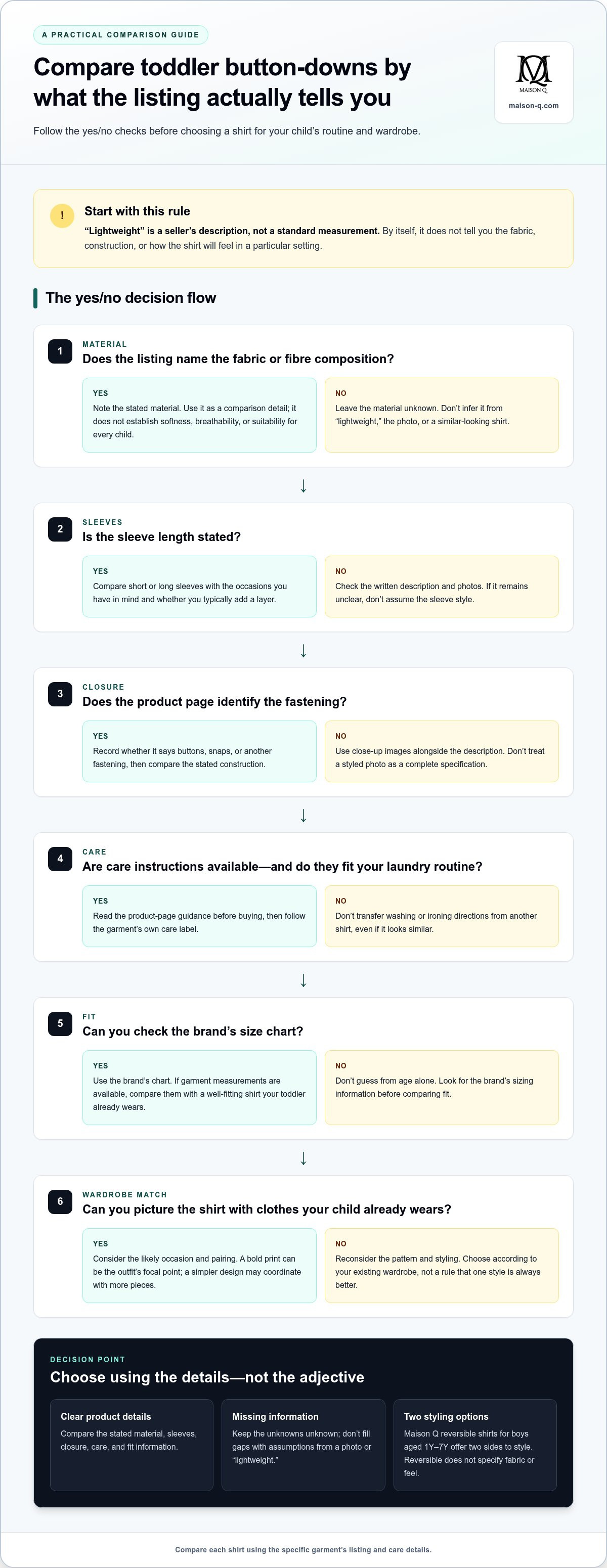
“Lightweight” is a description used by a seller, not a universal measure of fabric weight, construction, or temperature suitability. Treat it as a prompt to read the rest of the listing, rather than proof of how a shirt will feel or perform.
Start with the details the product page provides. A specific material description, sleeve length, closure, and care instructions give you more to compare than a broad adjective. Then picture the shirt with familiar trousers or shorts. A bold print can be the focal point of an outfit, while a simpler design may coordinate with more pieces. Choose according to the wardrobe you have, not an assumption that one style is always better.
This is especially helpful when comparing lightweight button down shirts for toddler boys across different listings. One seller may name a fabric, while another may use “lightweight” without further detail. Keep each product’s information separate: don’t assume that two shirts with similar descriptions share the same material or construction. Maison Q’s reversible shirts offer two sides to style, but the word “reversible” does not by itself describe a garment’s fabric or feel.
For general background on how shirts and collars are described, explore this overview of the history and types of dress shirts. For a buying decision, use the individual product listing to check details about the specific garment.
What does lightweight mean in a toddler shirt listing?
“Lightweight” is a descriptive term, not a standard measurement. On its own, it doesn’t tell you the shirt’s fabric, construction, or how it will feel in a particular setting. Read the surrounding product details and note what the seller specifies. If a feature is not described, don’t infer it from the adjective or a photograph. Compare products using the information each listing actually provides.
When might a toddler boy wear a button-down?
Think first about the occasions in your family’s routine. For everyday outings, a shirt that coordinates with the child’s usual shorts or trousers can be easy to work into existing outfits. A family gathering may call for a more coordinated combination, while a dressier event might inspire a neater pairing or an added layer. These are styling options, not rules. Consider what your child likes to wear and move around in, as well as which pieces the shirt can complement.
How to Assess Fabric Details, Sleeves, and Care Before You Buy
Product listings can make shirts sound similar, so focus on the details that help you compare one garment with another. Treat “lightweight” as one description to investigate, not a shortcut for deciding how a shirt will feel. A fabric name identifies the stated material, but it does not establish softness, breathability, or suitability for every child. Use the listed information alongside your family’s preferences and laundry routine.
Before buying, scan the stated fabric composition, sleeve length, closure, and care instructions. This checklist helps you compare lightweight button down shirts for toddler boys without filling gaps in the description with assumptions.
- Material: Note the fibre composition given in the listing. The material description tells you what the shirt is made from, but not everything about how it will feel to your child.
- Sleeves: Compare short and long sleeves in relation to the occasions you have in mind and whether you typically add a layer. Choose based on how you expect to style the shirt.
- Closure: Check whether the product page identifies buttons, snaps, or another fastening. Written details and close-up images can help you understand the visible construction.
- Care: Read the product-page instructions before buying, then follow the garment’s care label. Similar-looking shirts may have different care requirements.
Photographs can help you inspect the collar, front closure, sleeve shape, and overall design. Use them together with the written description, rather than treating a styled image as a complete specification. If an important detail is not stated, don’t assume it from how the shirt looks.
Which listed details help compare lightweight shirts?
Compare listings one point at a time. If you’re deciding between short and long sleeves, for example, consider the planned occasion and whether you like to layer. Next, check the written description and images for the closure and overall design. A quick side-by-side comparison makes differences easier to spot than relying on “lightweight” or choosing based on one appealing photograph.
How should parents think about care instructions?
Care guidance belongs in the buying decision, not just the laundry routine after purchase. Read the product-page instructions first and the garment’s own label when it arrives. Don’t transfer washing or ironing directions from one shirt to another, even if they look alike. If your household follows a particular laundry routine, check that the stated instructions fit it before choosing.
For a shirt with more than one styling option, explore Maison Q’s reversible shirts for boys, offered for ages 1Y-7Y. Review the details for the specific garment and follow its listed care guidance.
Button-Down Shirt Comparisons: Which Details Matter Most for Toddlers?
A button-down can work beyond special occasions. Its overall look depends on details such as sleeves, pattern, closure, and what you pair it with. A printed shirt with shorts may feel more relaxed, while a quieter pattern with neat trousers may look more dressed up. Use the comparison below as a starting point, not a set of rules. The right choice depends on your plans, your child’s routine, and the clothes already in the wardrobe.
| Detail | Options to compare | Possible wardrobe role |
|---|---|---|
| Sleeve style | Short or long sleeves | Consider the planned occasion and whether you like to layer. Either may work with different outfits. |
| Visual pattern | Plain, subtle pattern, or playful print | A quieter design may coordinate with more pieces; a bolder print can become the outfit’s focal point. |
| Closure | Buttons, snaps, or another listed fastening | Compare the stated construction and appearance with your preferences for dressing and styling. |
These distinctions help you compare lightweight button down shirts for toddler boys without assuming that one style is more comfortable or better made. For example, a printed short-sleeve shirt and a long-sleeve plaid shirt differ in style, but those descriptions alone don’t tell you how either will feel or whether it will suit every child. Check the product details, then match the garment to your needs.
Short sleeves or long sleeves: which suits the occasion?
Start with where your toddler is likely to wear the shirt. Short sleeves may suit a simple outfit, while long sleeves may work with a planned layer or a more covered look. Consider the event and the clothes you already own. A sleeve length that works with several outfits can make the shirt easier to reach for on different occasions.
Plain, printed, or patterned: how to choose?
A plain shirt or subtle pattern may coordinate with several bottoms, while a playful print can give an outfit more personality. Either can work for everyday wear or an event. If your child’s wardrobe already includes bold prints, a simpler shirt offers a contrast. If most pieces are understated, a lively design can add a colourful accent.
Closures also affect a shirt’s appearance, so compare what the listing says and shows rather than assuming all button-downs are constructed alike. Build the outfit around clothes your child already wears and your own styling preferences. A polished look can still feel relaxed when the pattern, pairing, and occasion work together.
How to Choose the Right Size and Style for Your Toddler’s Wardrobe
A shirt can look appealing online but prove difficult to wear if its size or style doesn’t work with your child’s clothes. Make a more considered choice by looking at the brand’s sizing guidance, the occasions you have in mind, and what is already in the wardrobe. Toddler sizing varies between brands, so an age label alone may not tell you how a particular shirt will fit.
How can caregivers make a more confident size choice?
Start with the product’s own size chart and follow its measurement instructions. If garment measurements are provided, compare them with a similar shirt that fits your child well. Lay the existing shirt flat and measure the corresponding areas, using the same points described in the size chart. This gives you a practical reference without assuming that two brands use equivalent age labels or size names.
If your child’s measurements fall between sizes, check the brand’s fit guidance and compare any available garment measurements. Don’t automatically size up or down without product-specific guidance. If you plan to wear the shirt over another top, keep that in mind when reviewing the chart, but don’t assume a particular fit based on the word “lightweight.”
How can one shirt work across different outfits?
Start with combinations you can make from clothes your toddler already wears. Pair a button-down with familiar shorts or trousers for an everyday outfit; a different bottom or an added layer can make the look more dressed up. Wearing a shirt open over another top is another styling option when the garment’s design suits it. These are general outfit ideas, not claims about a particular shirt’s construction.
For families who enjoy changing up a look, a reversible shirt offers two sides to style. Maison Q’s reversible shirts for boys are offered in the 1Y-7Y age range. Think about how each side might pair with your child’s existing clothes, and use the size guidance for the specific item rather than assuming the reversible design changes the fit.
Before you buy, pause for this quick checklist:
- Size guidance: Have you used the brand’s chart and followed its measurement instructions?
- Intended use: Does the size suit how you plan to wear the shirt, including any layering?
- Wardrobe coordination: Can you pair it with familiar pieces to make more than one outfit?
For a two-sided option to consider as you plan outfits, explore Maison Q’s reversible shirts for boys aged 1Y-7Y.
Maison Q Reversible Shirts for Toddler Boys: A Two-Sided Wardrobe Option
A reversible shirt gives you two sides to choose from when putting together an outfit. For families who like to vary a look without choosing a different shirt, that design offers an extra styling option. It is a way to change the outfit, not a promise that the garment will last longer or suit every occasion.
Maison Q offers reversible shirts for boys aged 1Y-7Y. The brand has been creating reversible kidswear since 2015. When comparing lightweight button down shirts for toddler boys, treat a reversible design as a separate feature: “lightweight” alone does not describe a shirt’s material, fit, or performance.
When might a reversible shirt suit a toddler’s wardrobe?
Two sides give you two styling choices. You could choose one side to coordinate with a familiar pair of shorts, then turn the shirt over for a different combination. The appeal depends on the designs and clothes your child already owns, so consider each side on its own rather than assuming both will work equally well with every outfit.
If you’re exploring this approach across a child’s wardrobe, a guide to reversible kids clothes offers another way to think about two-sided styling. The idea is straightforward: one reversible garment gives you a choice between its two sides, while you can keep the rest of the outfit familiar.
Explore Maison Q’s toddler boys’ shirt range
Maison Q’s reversible shirts for boys are offered for ages 1Y-7Y. To decide whether one suits your toddler, look at the specific shirt and picture how each side might work with clothes already in the wardrobe. Use the garment’s own size guidance rather than relying on age alone. The two-sided design adds styling choice, while the right fit and outfit still depend on your child and your plans.
Before choosing, consider whether you like both sides as styling options, whether each could pair with something your toddler already wears, and whether the listed size guidance suits your child. These checks keep the decision grounded in the garment’s details while leaving room for the fun of choosing which side to wear.
Explore Maison Q’s reversible kidswear to discover reversible shirt options for boys. With two sides to style, a reversible shirt can bring a fresh combination to familiar wardrobe pieces.
Make Room for More Everyday Moments
A toddler’s wardrobe should work for the day ahead, whether that means exploring, visiting family, or changing plans. As you compare lightweight button down shirts for toddler boys, picture the moments you’d like the shirt to suit, not only the occasion that first caught your eye. A design that works with your child’s regular clothes can bring a polished touch to more than one kind of day.
Let your child’s personality guide the choice, too. You might prefer a simpler look that coordinates with familiar favourites, or a reversible design that lets you choose between two sides. There’s no single right answer. Choose the option that feels most useful and enjoyable for your family.
Ready to explore a two-sided option? Explore Maison Q’s reversible kidswear and find inspiration for your toddler’s next outfit.
Frequently Asked Questions
Is a lightweight button-down shirt suitable for toddlers?
It depends on your child, the occasion, and the specific garment. The word “lightweight” alone doesn’t tell you whether a shirt will suit your toddler. Before choosing among lightweight button down shirts for toddler boys, review the listed material, sleeve style, size guidance, and care instructions. Match those details to the activity you have planned instead of relying on the product label alone.
Can toddler boys wear button-down shirts every day?
A button-down can be part of everyday dressing if its design suits your child’s routine and your family’s preferences. Pair it with familiar basics, such as shorts your toddler already wears. If the day involves plenty of movement, consider whether the specific shirt suits your plans based on the product details. The right everyday style varies by garment and child.
How do I know what size button-down shirt to buy for my toddler?
Use the specific product’s size chart and follow its measurement guidance, since sizing can differ between brands. If garment measurements are provided, compare them with a shirt your toddler already wears comfortably. Check corresponding measurements rather than choosing by age alone. If your child falls between sizes, use the brand’s fit guidance and consider whether you plan to layer another top underneath.
Do lightweight toddler shirts always use cotton?
No. “Lightweight” is a descriptive term, not a promise that a shirt uses cotton or any other particular fibre. Check the individual product description for its stated material composition, and don’t draw conclusions from the word alone. A fabric name doesn’t automatically tell you how soft a garment will feel, how breathable it is, or what care it needs. Look to the product information for those details.
How should I wash a toddler boy’s button-down shirt?
Follow the care label or product-page instructions for that particular shirt. Care requirements can differ between garments that look similar, so don’t apply one shirt’s washing, drying, or ironing directions to another. If your household follows a particular laundry routine, read the care details before buying to see whether the stated instructions fit it.
Can a button-down shirt be worn for a family gathering and everyday outings?
It may work for both, depending on its design and the occasion. For a relaxed outing, pair the shirt with familiar casual pieces; for a family gathering, coordinate it with dressier items already in your toddler’s wardrobe. A print or colour can also change the overall impression. Consider the event and the individual shirt rather than expecting one style to suit every setting.
Are Maison Q reversible shirts available for toddler boys?
Yes. Maison Q offers reversible shirts for boys aged 1Y-7Y. The reversible design gives you two styling options in one garment, so you can choose the side that suits the outfit you have in mind. Explore Maison Q’s reversible kidswear to see the shirt options.