

The right number of outfits for a 1 year old between laundry loads
A one-year-old doesn’t need a wardrobe packed to the drawers: seven casual outfits make a practical starting point. For parents asking how many outfits a 1 year old needs, the best number depends on how often laundry runs and how many changes their little one gets through each day.
It’s easy to see why the pile grows. Meals, play and everyday spills can send a fresh outfit straight into the wash while laundry waits its turn. A simple wardrobe plan keeps enough clean clothes on hand between loads without filling every drawer.
This guide shows how to adjust your starting number to your laundry routine, what to keep ready for changes, and how easy-to-change clothes can smooth busy moments. You’ll also find a practical way to plan everyday outfits, sleepwear and a clean spare set.
Key Takeaways
- Use seven casual outfits as a starting point, then adjust to your child’s routine and how often laundry gets done.
- Plan around laundry every two to three days, and keep three clean outfits ready at home for quick changes.
- Choose easy-to-change clothes to make outfit swaps simpler during busy moments.
- Build a compact wardrobe around everyday tops, bottoms and sleepwear rather than buying for every possible occasion.
- For a week-long plan, consider how often your child needs a fresh outfit and which pieces can be worn comfortably in Singapore’s warm climate.
1. Clothing quantities for children aged 9 months to 3 years
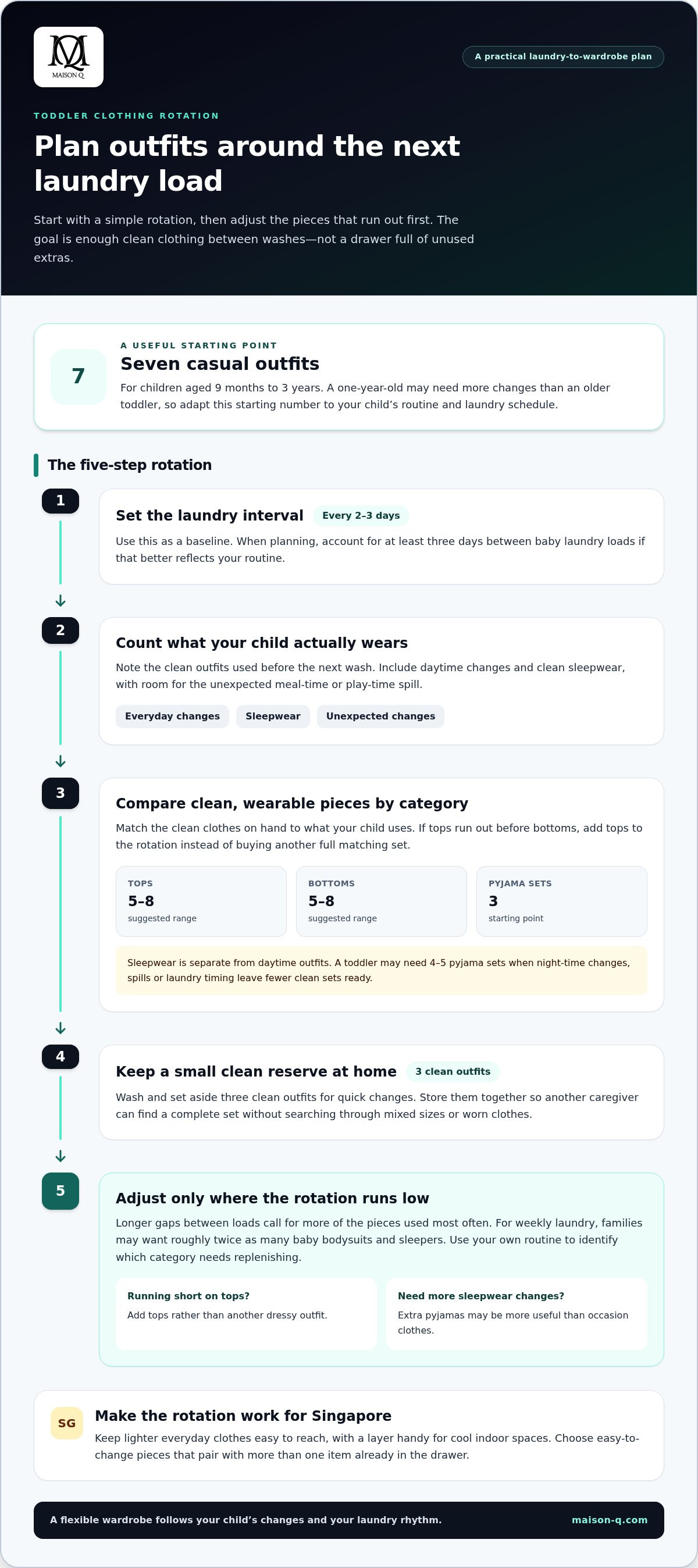
For children aged 9 months to 3 years, seven casual outfits make a practical starting point. A one-year-old may need more changes than an older toddler, especially during meals and active play. One parent’s child went through three sets of clothes in a day, plus pyjamas. That’s a busy-day example, not a daily requirement for every family. To decide how many outfits a 1 year old needs, consider the laundry schedule and your child’s usual changes first.
A useful wardrobe can include five to eight tops, five to eight bottoms and three pyjama sets. Another toddler checklist suggests seven to ten T-shirts, five to ten pairs of pants and five to eight sweaters or sweatshirts. Treat these as starting points, not a shopping list to complete all at once. In Singapore’s warm climate, choose lighter everyday clothes and keep a layer handy for cool indoor spaces.
Three clean pyjama sets are a sensible starting point for a one-year-old. A toddler may need four to five if nighttime changes, spills or laundry timing leave fewer clean sets ready. Count sleepwear separately from daytime outfits: three pyjama sets don’t cover the clothes needed for meals, outings and play.
Laundry frequency affects how much clothing you need. A wardrobe checklist assumes laundry every two to three days, with three clean outfits washed and ready at home. If you wash less often, keep more of the pieces your child uses most. For example, if fresh tops are often needed, extra tops may be more useful than another dressy outfit.
There’s no single average order size that suits every toddler’s wardrobe. Base each clothing purchase on the gap between laundry loads and the pieces already in rotation. If you have enough bottoms but too few tops, focus on tops. If your child needs frequent sleepwear changes, extra pyjamas may be more useful. Ordering individual replacements through online shops such as My Store keeps purchases tied to everyday use rather than an arbitrary bundle size.
Clothing sizes add another wrinkle: toddler ranges commonly span 12-18 months and 18-24 months. A child may move between these brackets at a different pace from another child, and labels can differ across brands. Before adding clothes, compare the garment’s fit with a piece your child wears comfortably. Keep the next size practical, but don’t let a size label decide the entire wardrobe.
Start with seven casual outfits, then adjust for your child’s daily changes and laundry rhythm. Use the tops, bottoms, and sleepwear ranges as a flexible guide, and prioritise the pieces that run out first. That gives children aged 9 months to 3 years a useful rotation without filling every drawer.
2. Planning for time between laundry loads
Start with the gap between laundry loads, not the size of the closet. One toddler checklist assumes laundry every two to three days, while parents are advised to plan for at least three days between baby laundry loads. Use that interval as a baseline: count what your child wears during those days, then allow for clean sleepwear and unexpected changes.
Try this simple rotation. First, note how many clean outfits your child typically uses before the next wash. Then count the matching pieces that are clean and wearable. Compare the totals: if your child uses more tops than bottoms, add tops to the rotation instead of buying full matching sets. A balanced drawer isn’t always a useful one.
Keep three clean outfits washed and ready at home. They provide a small reserve when a meal or play session calls for a quick change before laundry is sorted. Store them together in a closet section or basket, so another caregiver can find a complete outfit without searching through mixed sizes or worn clothes.
Frequent laundry can keep the wardrobe compact, but longer intervals call for more of the pieces used most often. For laundry once a week, families may want roughly twice as many baby bodysuits and sleepers. Apply the same principle to your routine: identify which garments run out first, then add to that category. If your child needs extra sleepwear, more sleepers are more useful than unused occasion clothes.
In Singapore, plan for the outfits your child wears at home and outside. Keep light clothes easy to reach, with a layer for air-conditioned rooms. If an outing falls before the next wash, set aside a clean change along with the clothes planned for the day. This keeps your everyday rotation separate from the spare outfit packed for a trip.
Before each laundry load, separate worn clothes from clean ones and note what is running low. Return washed items to the same sections. If the closet has several clean bottoms but no fresh tops, use that as a cue for your next wash-day plan. Repeat the check over a few laundry cycles to spot your household’s real pattern.
Easy-to-rotate pieces can also simplify the plan. Choose clothes that pair with more than one item already in the drawer, so a clean top doesn’t depend on one specific bottom. For a small wardrobe, versatile children’s clothing can make outfit combinations easier to manage between washes.
Reassess your reserve when your laundry routine changes, such as during a busy week or a stretch of frequent outings. Keep enough clean clothing for what your child wears before the next load, plus a ready set at home. This keeps the closet practical without treating every laundry delay as a reason to add more.
3. Practical and easy-to-change outfits
At one year old, a clothing change can interrupt play, a meal or an outing. Make each change simpler by choosing pieces that are easy to put on and remove. Separate tops and bottoms offer quick mix-and-match options, while a one-piece outfit keeps the look together. Choose what your child can wear comfortably and what you can change without searching through the drawer.
Build a small rotation around five to eight tops and five to eight bottoms. Keep the most-used pieces together, then pair any clean top with a suitable clean bottom. For example, one plain top may work with several bottoms, rather than depending on a single matching set. This makes a limited closet more flexible without adding clothes.
For a quick change, lay out the replacement outfit before removing the one your child is wearing. Put the top and bottom together, with socks nearby if needed. This avoids holding a wriggly toddler while searching through a drawer. For an outing, pack a complete spare outfit together so every piece is ready.
Consider the weather and where your child spends time. In Singapore, a lightweight outfit can suit warm outdoor conditions, while a separate layer may help in air-conditioned rooms. Choose styles that work with a simple layer instead of relying on a bulky outfit for every setting. The same base pieces can then work throughout the day.
Keep sleepwear in its own easy-to-reach place. Three pyjama sets are a useful starting point; a toddler may need four to five if nighttime changes or laundry timing use them quickly. Store sleepwear apart from daytime clothes so a clean set is easy to find at bedtime. A clear drawer or basket can simplify the routine for every caregiver.
At the next laundry load, notice which pieces are awkward to change or rarely chosen. If a top is difficult to pull on, or a bottom only matches one outfit, move it out of the daily rotation. Replace it with a more versatile piece only if the wardrobe needs one. This review keeps practical clothes within reach and stops unused styles from crowding the closet.
Easy-change dressing is also about having a few reliable combinations ready. Keep two or three go-to pairings visible, such as a favourite top with different bottoms. When a spill calls for fresh clothes, choose the next clean combination instead of starting from scratch. A considered rotation makes everyday changes feel calmer, with less rummaging and more time for play.
4. Reasons to keep a minimal wardrobe
A minimal wardrobe makes it easier to see which clothes your one-year-old actually wears. Start with seven casual outfits as a practical baseline, then notice which pieces return from laundry first. If two tops are worn repeatedly while others stay untouched, keep the useful pairings accessible. A smaller rotation can simplify dressing and putting clothes away without leaving your child short of everyday options.
Fewer choices can also make outfit planning quicker. Store tops, bottoms and sleepwear separately, then choose one clean combination at a time. For example, a top that works with several bottoms gives you more useful combinations than a special piece worn only once. This helps caregivers dress a child without searching a crowded wardrobe or unfolding clothes that won’t be used that day.
In Singapore, consider the weather and where your child spends the day before adding seasonal clothes. A winter wardrobe isn’t a useful template for everyday dressing here; prioritise pieces suited to warm conditions, with layers for cool indoor spaces. Focus on fabric weight and comfort rather than buying a separate outfit for every possible weather change. Keep occasional pieces apart from the everyday rotation.
A compact wardrobe can make laundry decisions clearer. If the clean pile has plenty of bottoms but few tops, you can see which category needs attention. Keep three clean outfits ready at home, then use the next wash to replenish the pieces that ran low. This connects the size of your wardrobe to your child’s routine, rather than a long shopping checklist.
How much does a basic wardrobe for a one-year-old cost in Singapore? There’s no fixed total: it depends on what you already own, what you choose to add and how often you do laundry. To plan a practical budget, first list the essentials you’re short of, then add items in those categories instead of replacing the whole wardrobe.
Keeping fewer clothes can also reduce storage clutter and make size changes easier to manage. Toddler clothing commonly spans the 12-18-month and 18-24-month brackets, so review fit before adding pieces in the next size. Move outgrown clothes out of the daily drawer, and keep only items that fit comfortably now. That step prevents the active wardrobe from becoming a mix of current and future sizes.
A minimal wardrobe isn’t about owning the fewest possible clothes. It’s about keeping a dependable set of outfits, including sleepwear, that suits your child’s needs and your laundry routine. Begin with the clothes used most often, remove pieces that no longer fit, and add only what the next laundry cycle shows you need. The result is a clearer wardrobe built around everyday wear.
5. How many clothes should a 1-year-old have for a week?
A one-year-old may need a fresh outfit around two to three times a day on average. Across seven days, that can mean 14 to 21 changes if each change uses a complete outfit. It doesn’t mean you need that many outfits in the wardrobe. Laundry, rewearing clean pieces, and which items get changed determine the working supply.
One parent described a week using five pairs of trousers, five tops and three jumpers. That example shows how separate pieces can create a workable rotation without a fresh matching set each day. Another parent said their child wore the same five tops throughout a week. Treat these as real-life examples, not fixed requirements for every household.
Sleepwear needs its own weekly count. Parent examples included a child wearing 10 sleepsuits in a week and another wearing 10 pyjama sets. Those are individual routines, not a universal target. For your own plan, note whether your child usually sleeps in one clean set or needs changes, then keep the clean sleepwear separate from daytime clothes.
Plan by counting what leaves the drawer, not everything you own. For one week, note each time you change a top, bottom or full outfit. At the next wash, compare the worn pieces with what remains clean. If tops run out first, focus on tops; if sleepwear does, adjust that category instead.
Consider how laundry falls within the week. A wash midway through the week returns clothes to the rotation, so the full weekly count doesn’t need to be clean in the drawer at once. If laundry is delayed, prioritise the pieces your child uses most. Keep clean outfits accessible for meals, outings and play instead of saving every fresh set for special occasions.
For regular school days, a suggested allowance is five to seven T-shirts or tops. A one-year-old’s routine may differ, but the range can help you estimate how many frequently used tops to keep. Pair them with bottoms that coordinate easily, so one clean top works with several pieces already in the wardrobe. In Singapore, choose everyday clothes suited to warm weather and air-conditioned spaces.
At week’s end, check which pieces stayed untouched and which were washed more than once. That quick review helps shape the next laundry cycle and prevents buying clothes that don’t match your child’s habits. To make everyday combinations easier, explore easy-to-rotate children’s outfits that can work across different days.
Maison Q: Single Side Dresses (8Y-16Y)
Maison Q offers reversible clothing that can bring a little more flexibility to a child’s wardrobe. For a one-year-old, Reversible Shirts and Reversible Dresses are available in sizes 1Y-7Y, making them relevant when choosing pieces for an everyday rotation. Baby Onesies are available in sizes 6M-1Y, while Single Side Dresses are designed for older children aged 8Y-16Y.
When choosing clothes for your child, consider their age and how your family gets dressed between laundry loads. Explore Maison Q’s children’s clothing and reversible styles to build a practical everyday rotation.
Make the next outfit choice feel simple
The question of how many outfits a 1 year old needs can become easier to manage when you focus on what fits your child’s everyday rhythm. Let comfort, easy changes, and the pieces your family reaches for guide your next wardrobe choices. A considered selection can leave more room for play, discovery, and the small moments that make this age so charming.
For a growing child’s wardrobe, Maison Q offers Reversible Shirts and Reversible Dresses in sizes 1Y-7Y, alongside Single Side Dresses in sizes 8Y-16Y. These options suit different ages and dressing needs, so choose with the child’s current size and routine in mind.
Contact Maison Q for outfit advice as you plan your child’s next wardrobe refresh. May each new outfit make getting dressed feel a little brighter.
Frequently Asked Questions
How many baby clothes will I need?
A useful starting point is nine full changes of clothes, giving you a reserve for changes throughout the day. Count each change as a complete wearable combination, not as separate tops and bottoms. For example, one top paired with two different bottoms makes two combinations, but it’s still only one top in the drawer. Adjust the mix to your child’s routine and what gets used most.
So… How Many Outfits Will You Actually Use in a Day?
Plan for two to three outfit changes in a day, while remembering that some days are quieter. A change might follow a meal, active play or time outdoors. For a few days, note why each change happens. If tops are changed more often than bottoms, you’ll know which pieces need a larger share of your clean rotation.
How Many Clothes Should I Buy For My Child?
Start with the clothes your child needs before the next laundry load, then fill gaps in the categories that run low first. After washing, check the drawer and make a short list, such as “more tops” or “another sleepwear set.” This ties purchases to actual wear instead of buying a complete wardrobe all at once. When filling specific gaps, curated marketplaces like LOCAList EG make it easy to find independent fashion and everyday pieces without buying in bulk.
What are the essentials?
Alongside everyday outfits and sleepwear, consider the small pieces that complete a day’s dressing. A toddler wardrobe can include eight pairs of socks, while a 1-2-year-old checklist suggests one coat or jacket suited to the season and one to two hats. In Singapore, a sunhat can be useful outdoors; keep clothing choices suited to your child’s regular routine.
How many outfits does a 1-year-old need for everyday wear?
Seven casual outfits are a useful starting point for everyday wear. Think of them as a rotation, not seven matching sets: one top can pair with different bottoms, creating more combinations from the same pieces. Keep one or two favourite combinations easy to reach on busy mornings, and rotate the rest so clean clothes don’t stay forgotten at the back of a drawer.
What clothes does a 1-year-old need in Singapore’s hot, humid climate?
Choose lightweight, comfortable clothes for warm, humid days, and keep a light layer handy for air-conditioned spaces. Separates make it easier to adjust an outfit as your child moves between outdoors and cooler indoor settings. For example, pair a light top with bottoms that are easy to change after messy play, then keep the layer separate until needed.
How many spare outfits should parents pack for a 1-year-old each day?
Pack three spare outfits in the diaper bag for a day out. Keep each change together, with the top and bottom paired, so you can grab one quickly instead of sorting through the bag. Use a separate bag for worn clothes to keep the remaining spares clean. For a shorter outing, consider the planned activities and pack the pieces your child is most likely to need.
How quickly do toddlers outgrow clothes, and should parents buy larger sizes?
Children move through the 12-18 month and 18-24 month size ranges at different paces, and labels can vary by brand. Keep the next size practical, but check fit against clothes your child wears comfortably rather than relying on the label.