

Sensory-Friendly Party Dresses: A Parent's Buying Guide
What if the prettiest party dress is the one your child barely notices wearing? Finding a non scratchy party dress for sensory sensitive girl starts with more than choosing a fabric that looks soft. A label, raised seam, snug fit or decorative detail can feel uncomfortable once she’s dressed, even when the outfit looks perfect on the hanger.
It makes sense to want her to feel festive without asking her to put up with clothes that bother her. Comfort is personal, so start by noticing what she avoids, adjusts or happily wears. Then compare those preferences with the dress’s fit, seams, layers and details.
This guide walks you through practical checks for fabric feel, seams, labels, fit and embellishments, plus a simple way to compare options. You’ll also find ways to include her taste, whether she’s drawn to the float of a fairy tulle dress or a more polished occasion look. The goal is an outfit that feels special to her throughout the celebration, not just in photos.
Key Takeaways
- Use your girl’s comfort cues to define what a non scratchy party dress for sensory sensitive girl means for her. A fabric label alone can’t tell you how she’ll experience a dress.
- Compare options by how they feel, fit and move, and by your child’s response to the details.
- Keep try-ons brief and low-pressure. Give her time to sit and move before deciding.
- Explore fairy tulle dresses, formal wear and age-specific dress styles while keeping her comfort and personal taste in view.
Why a Non-Scratchy Party Dress Starts With Your Girl’s Comfort Cues
A scratchy seam or tight detail can turn a lovely celebration into a long countdown to changing clothes. A dress may look enchanting, but comfort depends on how it feels to the child wearing it. A non scratchy party dress for sensory sensitive girl isn’t defined by appearance alone. Judge each option against her preferences, from the first try-on to the end of the event.
Those preferences vary from child to child. One girl may barely notice a label, while another finds it distracting. A soft-feeling skirt may delight one child and bother another. Sensory experiences can be part of a broader picture, as described in this overview of Sensory Processing Disorder (SPD), but clothing reactions alone don’t diagnose anything. Observe without making assumptions or treating one difficult outfit as a permanent rule.
Comfort is personal
A fabric label can offer a clue, but it can’t tell you exactly how a dress will feel to your child. Her experience depends on the whole outfit: touch, fit, temperature, movement and how she feels that day.
Which clothing sensations might bother a child?
Look for patterns in what she touches, adjusts or tries to remove. Seams may rub; a tag or lining may feel distracting; a waistband, sleeve or closure may press against her body. Notice where and when she reacts. Does she tug at the neckline as soon as she gets dressed, or only after sitting for a while?
Not every refusal is about texture. A dress may feel too snug or warm, restrict movement, or be harder to wear because the child is already overwhelmed by the event. Ask what’s bothering her and consider the setting as well as the garment. One uncomfortable try-on is useful information, not proof that she’ll dislike every dress with a similar feature.
How to make comfort part of partywear planning
Start with her perspective. Ask simple, specific questions: “Does this feel scratchy anywhere?” “Is anything squeezing or pulling?” “Would you rather wear sleeves or leave your arms free?” If she’s unsure, offer a choice between two details rather than asking her to explain a sensation she can’t easily name. Her gestures and willingness to keep the dress on can also guide you.
Think about the celebration ahead. A short family gathering may call for different movement and comfort needs than an event with lots of sitting, dancing or outdoor time. Comfort doesn’t mean giving up the magic of partywear. It means finding a look she enjoys wearing, so she can feel dressed up and take part on her own terms.
How Fabric, Seams, Linings, and Details Can Change Dress Comfort
A description such as “soft” is a useful starting point, but it can’t predict how a particular child will experience a dress. The fabric, seams, lining, trims and fit all affect how it feels. The same detail may be easy for one girl to ignore but distracting for another. For a non scratchy party dress for sensory sensitive girl, assess the whole garment against her preferences instead of relying on its fabric name or appearance.
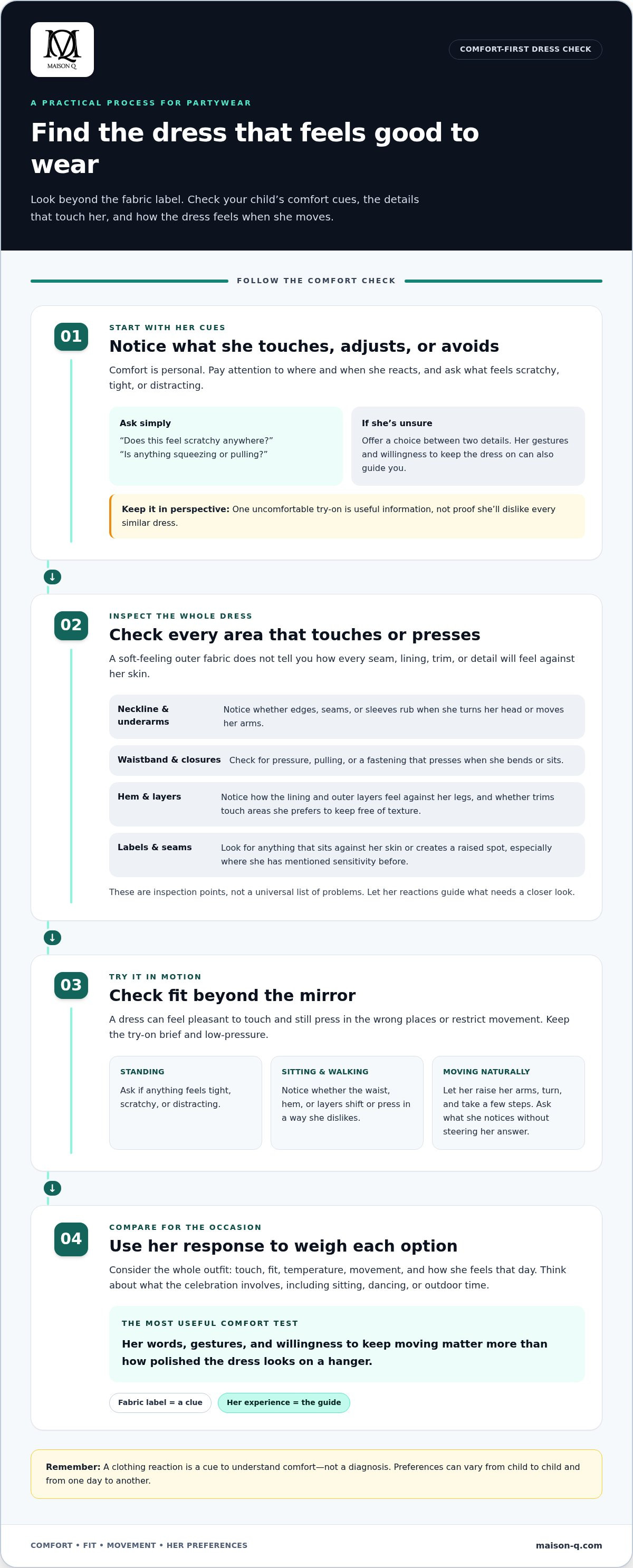
Your child’s response is the most useful comfort test. A close look can help you spot possible pressure points, but her feedback while wearing and moving in the dress matters most.
Check the areas that touch or press against skin
Inspect the dress inside and out, then focus on the places that meet or rest against her body. Look and feel gently, and invite her to touch a detail herself if she prefers. A smooth outer fabric won’t necessarily make every seam, lining or trim comfortable for her.
- Neckline and underarms: Notice whether edges, seams or sleeves rub when she turns her head or moves her arms.
- Waistband and closures: Check for pressure, pulling or a fastening that presses when she bends or sits.
- Hem and layered areas: Notice how the lining and outer layers feel against her legs, and whether trims or decorative details touch places she prefers to keep free of texture.
- Labels and seams: Look for anything that could sit against her skin or create a raised spot, especially where she has mentioned sensitivity before.
These are inspection points, not a universal list of problems. Lace, tulle, seams or a particular fabric may feel fine to one child and uncomfortable to another. Let her reactions guide what deserves closer attention.
Think beyond texture to fit and movement
A dress can feel pleasant to the touch and still be uncomfortable if it restricts movement or presses in the wrong places. Check whether sleeves allow her to raise her arms, whether the waistband feels comfortable when she sits, and whether the closure stays comfortable as she moves. Choose for the occasion’s likely activities, not just for a still moment in front of a mirror.
- While standing: Ask if anything feels tight, scratchy or distracting.
- While sitting and walking: Notice whether the waist, hem or layers shift or press in a way she dislikes.
- While moving naturally: Let her raise her arms, turn and take a few steps. Ask what she notices without steering her toward a particular answer.
Her words, gestures and willingness to keep moving tell you more than how polished the dress looks on a hanger. As you explore girls’ party dresses from Maison Q, use the same child-specific checks to weigh a special-occasion look alongside her comfort.
Compare Party Dresses With a Sensory-Sensitive Girl’s Checklist
Once you know which sensations matter to your child, compare dresses against the same short list of preferences. A consistent checklist makes it easier to look past polished product photos and notice practical differences. It also keeps the decision flexible: a detail that bothers one girl may feel perfectly comfortable to another.
Use a simple dress-by-dress comparison
Choose two or three options and note what your child likes, dislikes or hasn’t tried yet. The example below shows how to organise observations for a child who prefers room around the waist and enjoys a festive look. It’s an illustration, not a rule about any particular style or garment.
| Candidate | Feel | Fit | Details | Movement | Child’s response |
|---|---|---|---|---|---|
| Dress A | Feels comfortable on the areas she touched | Waist feels snug to her | Closure is not yet tried | Walking feels easy; sitting is untested | Likes the look, unsure about the waist |
| Dress B | One trim feels distracting | Waist feels comfortable | She notices the trim near the neckline | Raises arms without complaint | Enjoys moving in it, dislikes the trim |
| Dress C | No discomfort noticed during the try-on | Feels comfortable while standing and sitting | Details have been checked together | Can walk and turn comfortably | Smiles and wants to keep it on |
Write “not tried yet” rather than guessing. A fabric description or a dress’s appearance can’t replace your child’s feedback. These notes can help you see which option best suits her while leaving room for preferences to change with the occasion or the day.
Simplicity doesn’t have to mean plain. A graceful silhouette, a favourite colour or a softly gathered skirt can feel celebratory without relying on lots of embellishment. For styling inspiration, explore this kids party dress guide, then consider which ideas suit your child’s comfort cues.
Balance comfort preferences with the party’s dress code
First identify what the event calls for, such as formal attire or a festive birthday look. Then separate must-haves from optional details. The level of dressiness may be required, while trims, layers or particular sleeves may be styling choices. This makes it easier to find a look that feels special without overlooking her preferences.
For a birthday celebration, browse kids birthday party dress ideas for occasion-specific inspiration. Bring one or two promising options back to the same checklist, and let your girl’s response help settle the choice. If you're also planning your own celebratory outfit and exploring vintage-inspired occasion wear, you might find kittendamour.com helpful for classic 1950s styles.
Try On a Party Dress Without Turning Comfort Into a Battle
A try-on can be a calm rehearsal rather than a test your child has to pass. Choose a familiar moment when she isn’t rushed or already tired, and let her know she can take the dress off whenever she wants. The aim isn’t to persuade her to tolerate discomfort. It’s to learn what feels good enough for her to enjoy being dressed up.
A low-pressure fitting routine at home
Offer a choice between a small number of dresses, not a wardrobe full of possibilities. Let her decide which to try first, and keep the first try-on brief. Ask about one area at a time: “How does the neckline feel?” or “Is anything pulling at your waist?” Specific questions can make it easier to share what she notices than a broad “Is it comfortable?”
Give her time to answer in her own way. She might use words, point to a spot, tug at a sleeve or simply ask to change. Treat those signals as useful information. If she’s uncomfortable, stop and help her out of the dress rather than asking her to endure it. A quick note such as “likes the shape, seam bothers her under the arm” is more helpful than ruling out the whole style.
Once she’s ready, invite her to sit, walk and raise her arms. Watch for pulling, shifting or repeated adjustments, and check in without turning every movement into a question. If one detail is the problem, consider whether a familiar layer or a different silhouette might make the outfit feel better. If she still wants to change, that’s a clear answer too.
Plan for the event, not just the mirror
A dress that feels fine during a brief try-on may feel different during a longer celebration. Think about the plans: will she be sitting through a meal, moving around, dancing or spending time outdoors? Consider how long she’s likely to wear the outfit and what she usually finds comfortable in similar situations. This helps you choose for the day ahead, not only for the moment she sees her reflection.
Agree on a simple signal she can use if something starts bothering her, such as saying “pause” or gently tapping your hand. Knowing she can ask for a break or a change can make getting dressed feel less pressured. If it would help her feel secure, pack a familiar backup outfit or layer that suits the celebration and is easy to change into.
Let her comfort set the pace. A festive look should leave room for the child wearing it: a favourite detail, a shape she enjoys and the freedom to take part without being asked to ignore irritation. If you’re exploring a non scratchy party dress for sensory sensitive girl, browse Maison Q girls’ party dresses and use this gentle try-on routine to see how each option feels to her.
Explore Maison Q Girls’ Party Dresses With Comfort in Mind
A special-occasion look can feel dreamy and polished while reflecting what your child enjoys wearing. Maison Q’s girls’ dress styles include fairy tulle dresses, formal wear, reversible dresses for ages 1-7 and single-side dresses for ages 8-16. These categories offer different style directions to explore, but your girl’s comfort depends on her own preferences and response to the details of a particular dress.
Choose a style direction before narrowing the details
Start with the occasion and your child’s taste. She may love the light, celebratory look of tulle, prefer the refinement of formal wear, or feel most herself in a different silhouette. Explore fairy tulle dresses for girls for a special-day style with a fairytale mood. Treat each style as a starting point, then assess the individual dress rather than assuming one category will suit every child.
Age ranges can help narrow your search. Maison Q’s reversible dresses are offered for ages 1-7, while single-side dresses are offered for ages 8-16. These are distinct categories to consider alongside fairy tulle dresses and formal wear. Let your girl’s preferences guide the choice: the event sets the occasion, but her comfort cues and personal style should help shape the final look.
Make the next step feel simple
Before choosing, revisit the details your child has identified as comfortable or bothersome. Consider how the dress feels in the places she notices, how the fit works for her and whether she likes the look. If you’re searching for a non scratchy party dress for sensory sensitive girl, keep her feedback at the centre of the decision. Product categories and photographs can help you find a style direction, but they can’t establish how a particular dress will feel to her.
Keep the comparison straightforward. Choose a few promising styles, note what she has tried and liked, and leave anything uncertain as something to assess rather than assume. Browsing this way keeps the focus on occasion-ready looks she’s drawn to, with her comfort preferences part of the decision from the start.
Maison Q sells online and through stockists, with worldwide shipping available. Browse Maison Q’s girls’ dress styles for a party or special occasion, then use your child-specific checklist to decide which options to consider. The aim isn’t to find a style that makes a promise on her behalf. It’s to find a festive look she feels good choosing for herself.
Let Her Comfort Lead the Celebration
The right party look is one your girl can feel good choosing, not one she has to tolerate for the sake of a photograph. As you browse, keep her preferences in mind and leave room for her to change them. A small detail she points out can help narrow the search more meaningfully than a label or picture alone.
Maison Q has created reversible kidswear since 2015. Its girls’ dress options include fairy tulle dresses and formal wear, reversible dresses for ages 1-7, and single-side dresses for ages 8-16. Each category offers a different starting point for finding a special-occasion look that suits her taste. Her own response should guide the comfort decision.
Let the search for a non scratchy party dress for sensory sensitive girl be an opportunity to include her in the choice. Notice what she enjoys, respect what she’d rather avoid, and let the celebration begin with a little more ease.
Explore Maison Q girls’ dresses and find a party-ready style. The loveliest outfit is one that helps her feel like herself, with a touch of occasion-day magic.
Frequently Asked Questions
What makes a party dress sensory-friendly for a girl?
A sensory-friendly party dress is one that suits the individual child’s comfort preferences. There isn’t a universal fabric, cut or feature that works for every girl. Notice what she enjoys wearing on ordinary days, such as a roomy waist or sleeves she can move in, and use those preferences as a starting point for partywear. Her response to the dress matters more than a general “sensory-friendly” description.
Can a tulle party dress be comfortable for a sensory-sensitive child?
Yes. A tulle party dress can be comfortable for some children, but the fabric alone can’t predict how it will feel to your girl. She may enjoy the skirt’s shape but dislike how a particular layer rests against her skin. If she prefers a familiar base layer, try the dress with it and see whether the combination feels right to her. Let her decide whether she wants to keep it on.
How can I tell if a dress may feel scratchy before my child wears it?
You can look for possible irritants, but you can’t know for certain without your child’s feedback. Turn the dress inside out and inspect seams, labels, trims and closures. If shopping online—whether browsing independent boutiques or exploring everyday apparel and fashion collections on upstormed.com—look at product photos or descriptions for close-up details. A fabric that feels smooth to you may feel different to her. If possible, plan a brief try-on well before the event, leaving time to choose another option if needed.
Should I remove tags from a party dress if they bother my child?
If a tag bothers her, removing or altering it may help, but first check whether it contains care instructions you’ll need later. You could photograph that information before making a change. Take care not to cut into the fabric or seam, and stop if the tag is difficult to remove cleanly. A familiar layer between the tag and her skin may be another option if she prefers.
Can a sensory-sensitive girl wear a party dress with seams or lining?
Yes. Seams and lining don’t automatically make a dress uncomfortable. What matters is how their placement and feel affect your child. She might be comfortable with a seam along the side but notice one near the neckline, or enjoy a lined skirt while disliking how it feels at the waist. Use her feedback about the specific dress rather than ruling out every lined or seamed style.
What should I do if my child becomes uncomfortable in her dress during a party?
Respond to her signal and help her take a break from whatever is bothering her. Find a quieter spot if that helps, adjust the outfit only if she wants you to, and offer a familiar backup layer or change of clothes. Avoid asking her to stay in the dress for photos or to please guests. Later, note what changed, such as warmth, movement or a detail rubbing.
Does a sensory-friendly party dress have to be plain?
No. A comfortable party dress can still feel playful and special. Your child might love a particular colour, a flowing shape or one decorative feature, while preferring fewer details elsewhere. Start with what she enjoys and consider the overall feel of the outfit rather than assuming simple means comfortable or embellished means irritating. Let her help choose the details that make the dress feel like hers.