

Cute Toddler Boy Outfits That Make Diaper Changes Easier
What if a polished little look didn’t have to mean a complicated diaper change? Finding cute toddler boy outfits that are easy to diaper change starts with practical details: how you reach the diaper, how many layers you need to move, and how easily the outfit goes back on.
Fiddly layers and awkward fastenings can test everyone’s patience, especially when little legs are wriggling. A useful everyday outfit balances comfort, straightforward access and a bit of personality. Before choosing, picture the change itself: what needs to move, and how many pieces will you need to put back on?
This guide compares separates, one-pieces and layered looks, and explains what to check in each garment. Reversible shirts and unisex shorts can add playful styling options, but diaper-change convenience depends on a garment’s design and how it works with your routine. Use the checklist to choose clothes that suit your toddler’s movement and the day ahead.
Key Takeaways
- Look for openings you can manage easily and layers that are simple to move and replace.
- Compare separates, one-pieces and layered outfits by their actual construction, rather than assuming one style is always easier.
- Use a quick checklist for play days and outings, considering access, fit and how many layers you’ll need to handle.
- Choose cute toddler boy outfits that are easy to diaper change by prioritising practical construction, then add personality with colour or print.
- Explore reversible shirts for ages 1Y-7Y and unisex shorts as playful pieces for versatile everyday outfits.
Cute Toddler Boy Outfits: What Makes Diaper Changes Easier?
A toddler can turn a simple change into a lively little dance: twisting away, reaching for a toy or deciding that lying still is no longer on the agenda. The right outfit won’t make every change effortless, but straightforward access and fewer layers can mean fewer steps before play resumes.
A diaper-change-friendly outfit gives you practical access without unnecessary layers or steps. That might be separates that are easy to move independently, or a one-piece with an opening that suits your routine. The best choice depends on the garment’s design, your child’s movement and how you usually manage changes.
There’s no single format that works for every family or moment. A style that feels easy at home may be less manageable when you’re out, and a child who likes to stand may need a different approach from one who stays settled. Think about the details you’ll handle repeatedly, rather than choosing by category alone. An overview of children’s clothing offers useful context for how function and design meet in everyday dressing.
Everyday outfit details that can simplify a change
Start by counting the steps it takes to move the outfit aside and put it back on. Fewer layers mean less to lift, untuck or reposition. Check where openings sit and how they work: depending on the garment, snaps, a flexible waistband or another simple opening may make access more direct. These are details to assess on each item, not features shared by every style.
Consider comfort and movement, too. Clothing should allow your toddler to sit, crawl and play without needing constant adjustment. If changes often happen away from home, think about how many pieces you’ll need to manage in your usual changing setup. The most useful choice is the one that works for your child and your routine.
Cute style and practicality can belong together
Practical doesn’t have to mean plain. A lively print, a favourite colour combination or a neat silhouette can make simple separates feel considered without complicating the outfit. Pair a patterned shirt with understated shorts, for example, or let a bright top add character to a simple look.
Separates also let you change one piece without rethinking the whole outfit. That can be helpful when one item needs changing but the other is still wearable, or when you want to adjust a layer as the day unfolds. Choose details you enjoy, but pay attention to how the garment sits and moves. Decorative trim isn’t automatically more comfortable or convenient.
Before dressing your toddler, run through the change in your mind: what needs to move, where can you reach, and how many pieces will need to go back on? This quick test helps distinguish an outfit that looks charming from one that fits your everyday routine. With a little planning, cute toddler boy outfits that are easy to diaper change can feel polished without asking little ones to stay still for long.
Which Toddler Boy Outfit Features Make Changes Simpler?
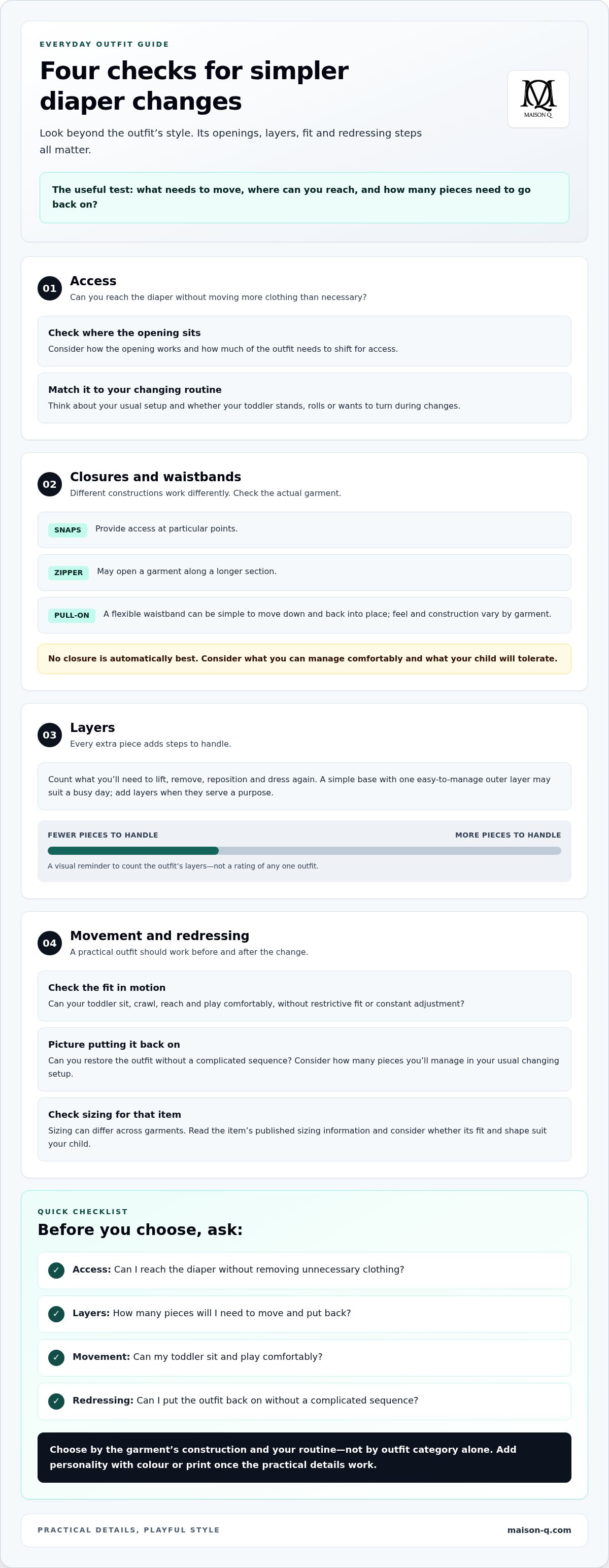
A cute outfit can look effortless on a hanger and feel less straightforward once a toddler is ready to wriggle away. Before choosing, check four things: how you reach the diaper, how many layers you need to move, whether your child can move comfortably, and how easily the outfit goes back on.
The most useful features provide clear access, allow comfortable movement and make redressing simple. Check the garment itself rather than relying on its general style. Construction varies, so look at its openings, closures and lower-half design.
Comfort matters as much as access. Think about how the clothing feels during ordinary movement and whether anything needs frequent adjusting. Your changing setup matters, too: an outfit that’s manageable on a changing mat may feel different when you’re helping a toddler who wants to stand or turn. Use your own routine to judge which details are genuinely helpful.
Closures, waistbands and access points
Different closures suit different caregivers and toddlers. Snaps provide access at particular points, while a zipper may open a garment along a longer section. Pull-on bottoms with flexible waistbands can be simple to move down and back into place, though the feel and construction vary by garment. No closure is automatically best. Consider what you can manage comfortably and what your child will tolerate.
Look at where an opening sits and how much clothing needs to shift. If your toddler stands or rolls during changes, consider whether the lower half is easy to adjust without handling extra layers. Think about your usual changing setup and your child’s mobility before deciding which details matter most.
Layers and fit for wriggly toddlers
Every extra layer adds steps: lifting, removing, repositioning and dressing again. A simple base with one easy-to-manage outer layer may suit a busy day better than several pieces. Layers can still be useful when you want flexibility, so choose them for a reason rather than by default.
Fit should allow ordinary movement, such as sitting, crawling and reaching, without feeling restrictive or requiring constant adjustment. Don’t assume sizing works the same across every garment. Read the published sizing information for the specific item, then consider whether its listed fit and shape suit your child and changing routine.
- Access: Can you reach the diaper without removing more clothing than necessary?
- Layers: How many pieces will you need to move and put back?
- Movement: Can your toddler sit and play comfortably?
- Redressing: Can you restore the outfit without a complicated sequence?
These checks help you weigh access, comfort and style together. For playful outfit-building options, explore Maison Q’s reversible shirts and unisex shorts. Consider how each piece fits into your child’s everyday rotation and changing routine.
Separates, One-Pieces, or Layers: Which Outfits Suit Your Routine?
Separates, one-pieces and layered looks each bring a different rhythm to getting dressed. Rather than assuming one format is always faster, consider how its openings work, how many pieces you’ll handle, and what suits your toddler’s routine. The best outfit choice matches your day to the garment’s construction.
Separates
Access: The top and bottom can be moved independently, though the lower-half design matters.
Layers: Usually limited to the pieces you choose to pair.
Versatility: Mix tops and bottoms for different looks or replace one piece as needed.
May suit: Everyday play and routines where adaptable dressing is useful.
One-pieces
Access: Depends on the garment’s opening and where it sits.
Layers: One garment can mean fewer separate pieces, but an added base or outer layer changes the equation.
Versatility: A ready-made, coordinated look.
May suit: Caregivers who prefer one garment and find its openings easy to manage.
Layered looks
Access: Depends on which pieces need moving to reach the diaper.
Layers: More pieces can mean more steps to remove and replace.
Versatility: Add or remove a layer as needed for the day’s plans.
May suit: Outings or moments when an extra styling piece is useful.
Use this comparison to weigh options, not to predict exactly how fast a change will be. A one-piece with an opening that suits your setup may feel simpler than separates that need readjusting. Another caregiver may prefer separates because only one piece needs to move. Check the specific garment and picture managing it with your toddler in their usual changing position.
Separates for flexible everyday dressing
A shirt-and-shorts combination lets you adjust each piece independently. A playful shirt with simple shorts, for example, can look thoughtfully styled without requiring a coordinated set. Unisex shorts can be part of this mix-and-match approach, while reversible shirts offer two looks in one piece. For more ideas on versatile styling, explore this reversible kids clothes guide. Reversibility adds styling options; access still depends on the garment’s design.
One-piece outfits and layered looks
One-pieces can keep an outfit visually simple, but convenience depends on their openings and how much of the garment needs to move during a change. Layers bring more styling options and can be useful when you want to add or remove a piece, but each layer adds a dressing step. Maison Q baby onesies are offered for ages 6M-1Y, so keep that baby sizing distinct from toddler outfit choices.
When choosing cute toddler boy outfits that are easy to diaper change, focus on the details you’ll handle repeatedly, not the category alone. What moves, what stays on, and how will you put it all back? The right format is the one that feels manageable for both caregiver and child.
How to Choose Cute Toddler Boy Outfits for Your Daily Routine
A useful outfit starts with the day ahead, not just the mirror. Think about where your toddler will play, how active they’re likely to be and how you prefer to manage changes. This makes it easier to balance a charming look with a dressing process that feels comfortable for both of you.
A quick checklist before choosing an outfit
Use these steps to turn a promising outfit into a practical choice:
- Start with the routine. Is this for everyday play, an outing or a day when changes are likely to be frequent? Picture where changes will happen and what your toddler may be doing between them.
- Check access. Look at the garment’s actual openings and consider whether they work with your usual changing setup. What needs to move? Can you manage it comfortably while your child is standing, sitting or wriggling?
- Count the layers. Decide whether each piece has a purpose for the occasion. A simpler combination may suit a busy day; an added layer can create a more styled look if you’re comfortable with another dressing step.
- Review fit and construction. Read the item’s published sizing information and examine its garment details. Choose a fit that allows your toddler to move comfortably instead of assuming sizing or construction will be the same across different pieces.
- Finish with style. Choose colours, prints or silhouettes you love, then consider whether the dressing process suits your routine. The right choice should feel delightful to wear and manageable to change.
Match the outfit to the day ahead
For everyday play, try a straightforward combination that lets your toddler move freely without involving more pieces than you need. Separates can be adaptable: if one item needs changing, you can consider it independently from the rest of the outfit. For a change on the go, focus on the garment’s access and how easily you can put it back on rather than assuming a particular category will always be faster.
Outings can invite a little extra polish. A playful print or considered colour pairing can make a simple look feel special while leaving room for your child to climb, sit and explore. Before adding a layer or decorative detail, think about whether it suits the plans and whether you’re happy to manage any extra steps.
A reversible shirt can add another styling option to the wardrobe. Maison Q offers reversible shirts for ages 1Y-7Y, with two looks in one piece. That versatility can help you vary an outfit, but diaper access depends on the specific garment’s construction. Let its design guide that decision.
A routine-first approach makes choosing cute toddler boy outfits that are easy to diaper change less about finding one perfect format and more about identifying what works for your family. Explore Maison Q children’s clothing for playful pieces to bring into your toddler’s everyday rotation.
Maison Q Pieces for Playful, Practical Toddler Boy Outfits
Everyday dressing can be practical and full of personality. Maison Q’s reversible shirts for ages 1Y-7Y and unisex shorts offer two useful outfit-building options: shirts that bring styling variety and shorts that can anchor a cheerful look. They’re pieces to consider for a toddler’s wardrobe. Diaper-change convenience depends on each garment’s access, fit and how it works with your routine.
Build a cheerful look with reversible shirts and shorts
A reversible shirt gives you two looks in one piece, making it easy to bring a different visual mood to an everyday outfit. Pair one side with unisex shorts for a playful combination, then switch the shirt’s look another day to refresh the pairing. It’s a simple way to create variety without needing a new outfit idea for every occasion.
Reversible styling is about versatility, not a special diaper-change feature. Assess the shirt’s construction and how it fits into your dressing routine, as you would with any top. For more inspiration on adaptable pieces, browse the reversible kids clothes guide. A favourite print or fresh colour pairing can bring charm to the day; practicality comes down to what feels comfortable for your child and manageable for you.
Unisex shorts can complete the look with an easy-to-mix-and-match feel. Pair them with a shirt that has a bolder visual presence, or let both pieces contribute colour and print. There’s no need to treat a top-and-shorts pairing as a named set. Think of each piece as a flexible part of your child’s everyday wardrobe. The best combinations leave room for play and feel like your toddler.
Choose with confidence and explore the collection
Before deciding, imagine the outfit in action. Can you reach the diaper as your usual routine requires? Will the combination suit your toddler’s movement and the day’s plans? Check the sizing information and details for each garment rather than assuming every shirt or pair of shorts fits or functions the same way.
That balance leaves room for both function and delight. A reversible shirt adds a styling option, while unisex shorts offer a versatile piece to mix into everyday looks. Neither is automatically quicker to change; the garment’s design and your preferences matter. Choose what feels right for your child, then enjoy getting them dressed for another day of discovering, playing and being themselves.
For playful children’s fashion and versatile pieces to build into your toddler’s wardrobe, discover Maison Q children’s clothing.
Make Room for Easier, More Joyful Dressing
Each day brings its own little wardrobe adventure. Let your child’s routine guide your choices, and make room for pieces that feel expressive as well as practical. The most helpful cute toddler boy outfits that are easy to diaper change are the ones that suit your preferences and your toddler’s real day, not just a picture-perfect moment.
Maison Q’s reversible shirts for ages 1Y-7Y and unisex shorts are playful pieces for building everyday outfits. Reversible styling offers another look to enjoy, while each garment’s construction determines how it works for access and dressing. A thoughtful wardrobe can hold both: clothes that fit your routine and pieces that bring delight to getting dressed.
Choose an outfit for tomorrow with your usual routine in mind, then notice what makes it comfortable for everyone. Small, considered choices can make dressing a sweeter part of the day. Discover Maison Q children’s clothing and find inspiration for your toddler’s next playful look.
Frequently Asked Questions
Is a two-piece outfit easier for diaper changes than a one-piece?
Neither format is automatically easier; the garment’s openings and your changing routine matter more. Separates let you adjust the top and bottom independently, which can help if only one piece needs moving. A one-piece may suit you just as well if its openings are easy to manage. Before choosing, picture using the outfit at home or on an outing and consider how comfortably your toddler can move in it.
What features should I look for in toddler clothes for quick diaper changes?
Prioritise access you can manage confidently, fewer unnecessary layers and closures that suit your routine. Consider whether you can adjust the lower half without taking off several other pieces. Check the item’s description and sizing guidance, then think about your toddler’s habits: a child who likes to stand may need a different approach from one who stays settled.
Can toddler boys wear shorts for easier diaper changes?
Yes, shorts can be part of a practical toddler outfit, but they don’t automatically make changes easier. Consider how the waistband works for you and whether the fit leaves room for your child to sit, climb and play. A shirt and shorts may suit a playground visit if both pieces are comfortable and manageable. Judge the complete outfit, not the shorts alone.
Are reversible shirts practical for toddler outfits?
They can be a versatile styling choice, offering two looks in one piece. Reversibility itself doesn’t determine diaper-change access, so consider the specific shirt’s design and how it fits into your routine. Maison Q offers reversible shirts for ages 1Y-7Y. Pair one with different bottoms to vary an everyday look, and review the item’s sizing information and garment details before choosing.
How should I dress a toddler boy for quick changes when going out?
Choose an outfit suited to the outing and your child’s activity, with openings you can manage and only the layers you’re comfortable handling. For a short errand, a top and shorts may feel straightforward if they fit your toddler well. For a longer day, think through where you might change and whether an extra layer will be easy to remove and put back on.
What size clothing does Maison Q offer for toddlers?
Maison Q offers reversible shirts in ages 1Y-7Y, baby onesies in ages 6M-1Y, and unisex shorts. These labels refer to different product categories, so don’t assume every piece shares the same age range. For a specific outfit, use the sizing information published for each item and consider how you want it to fit your child’s movement and dressing routine.